
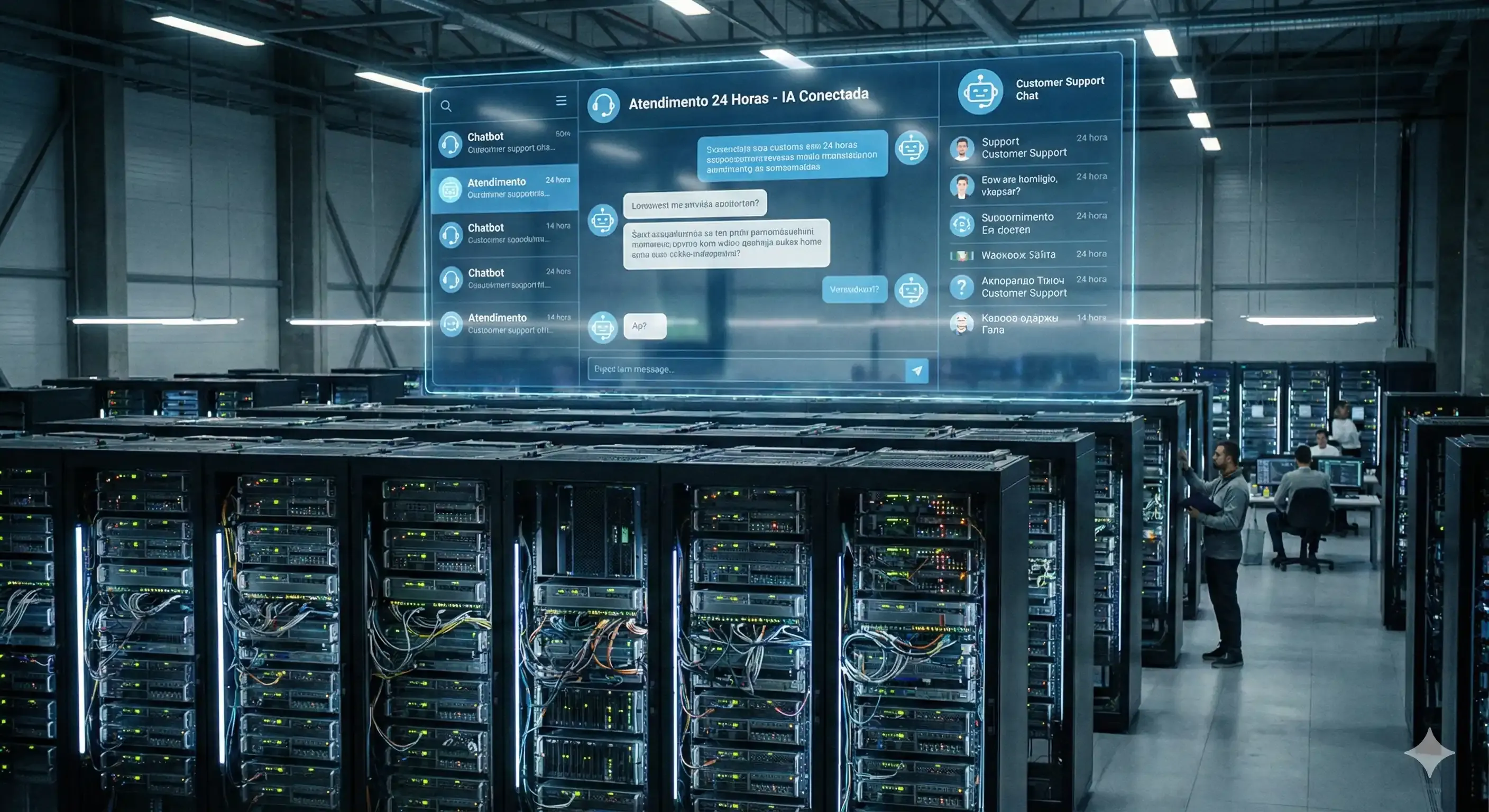
Companies Invest in AI for 24/7 Customer Support
Intelligent chatbots improve customer support and reduce operational costs.
Have you ever lost a sale because a customer sent a question at 7 p.m. on a Friday and your team only replied on Monday morning? If the answer is yes, you’re not alone.
In today’s digital landscape, the concept of “business hours” is obsolete. The modern consumer is always-on and expects immediate responses. The good news is that Artificial Intelligence (AI) technology has evolved from “rigid bots” into virtual assistants capable of holding fluid, empathetic, and solution-oriented conversations.
The problem: A math equation that doesn’t add up
For most small and medium-sized businesses (SMBs) — and even large corporations — maintaining a human support team available 24 hours a day, 7 days a week is financially unfeasible.
Beyond payroll costs, there are night shift premiums, labor charges, and shift management. On the other side of the equation lies the cost of no support at all:
- Increased Churn: Customers frustrated by delays switch to competitors in just a few clicks.
- Overloaded Teams: Human agents spend up to 70% of their time answering repetitive questions (“What’s the price?”, “Where is my order?”), leaving little energy to solve complex issues.
- Inconsistency: Service quality varies depending on the agent’s mood or fatigue.

The solution: Hybrid and Intelligent Support
The solution is not to replace humans with robots, but to create a hybrid workforce. AI acts as the first line of defense, operating 24/7 without breaks.
Unlike older chatbots based solely on buttons and rigid keywords, modern solutions use LLMs (Large Language Models) and Natural Language Processing (NLP) to understand context.
How does it work in practice?
Here’s how leading companies are structuring their workflows:
- Intelligent Triage: AI receives the message, identifies the customer by number (integrated with the CRM), and understands intent.
- Autonomous Resolution: For issues like invoice reissues, delivery status, or scheduling, AI resolves the request independently by consulting the company’s database.
- Human Handoff: If the AI detects a complex issue or negative sentiment (frustration/anger) in the customer’s message, it immediately transfers the conversation to a human agent — along with a summary of what has already been discussed.

Real-World Use Cases
- E-commerce: “Where is my order?” is answered instantly with a tracking link, reducing support tickets by up to 40%.
- SaaS (Software): AI trained on technical documentation helps users configure tools step by step, acting like an on-demand support technician.
- Clinics and Services: Appointment scheduling and confirmations are handled automatically via WhatsApp, reducing no-shows.
What the market says: According to the Zendesk CX Trends Report, over 70% of consumers expect immediate interaction when contacting a company. Additionally, Gartner predicts that chatbots will become the primary customer service channel for a quarter of organizations by 2027.
Practical implementation checklist
Ready to get started? Don’t try to do everything at once. Follow this roadmap:
- Demand Audit: Export tickets from the last 3 months and identify the 10 most frequent questions (Pareto Principle: 80% of questions come from 20% of topics).
- Knowledge Base: Organize answers to these questions in a clear document. Your AI will only be as good as the information you provide.
- Tool Selection: Choose platforms that support integrations (such as Typebot, Chatwoot, or N8N) and include seamless human handoff.
- Training Phase (Playground): Test the bot internally. Try to “confuse” it to fine-tune safety responses.
- Continuous Monitoring: During the first few months, review AI conversations to refine tone of voice and accuracy.

Conclusion
Investing in AI-powered 24/7 customer support is no longer a competitive advantage — it’s a survival requirement. The technology frees your team to be strategic and empathetic, while ensuring your customers are never left talking to themselves.
If you want to automate your support, integrate WhatsApp, CRM, and AI in a personalized way, talk to Ailian. We transform your operation to run on autopilot — with the security your business needs.